


Rethinking Quality Assurance Lessons from LUMS’ RIPE Experience
In our previous blog, we introduced the Review of Institutional Performance and Enhancement (RIPE) and explained how it represents a major shift in HEC’s (Higher Education Commission) quality assurance framework - from compliance-based evaluation to continuous improvement. RIPE is an HEC initiative designed to evaluate and improve the overall quality, performance, and effectiveness of higher education institutions. In this second part, we share LUMS’ first-hand experience of implementing RIPE. As one of the leading universities of Pakistan, LUMS adopted the Review of Institutional Performance and Enhancement (RIPE) and had the opportunity to experience the framework in practice and reflect on what it means for institutional growth. While RIPE marks a positive shift from compliance to continuous improvement, the transition was not without its challenges. Our experience highlighted the practical realities of implementing a new quality assurance process - ranging from coordination and data collection to building awareness and ownership across the university. These challenges, however, became valuable learning opportunities that continue to shape how LUMS approaches quality enhancement.
Challenges faced during RIPE
Source: LUMS Presentation on RIPE at HEC Progress Review Meeting
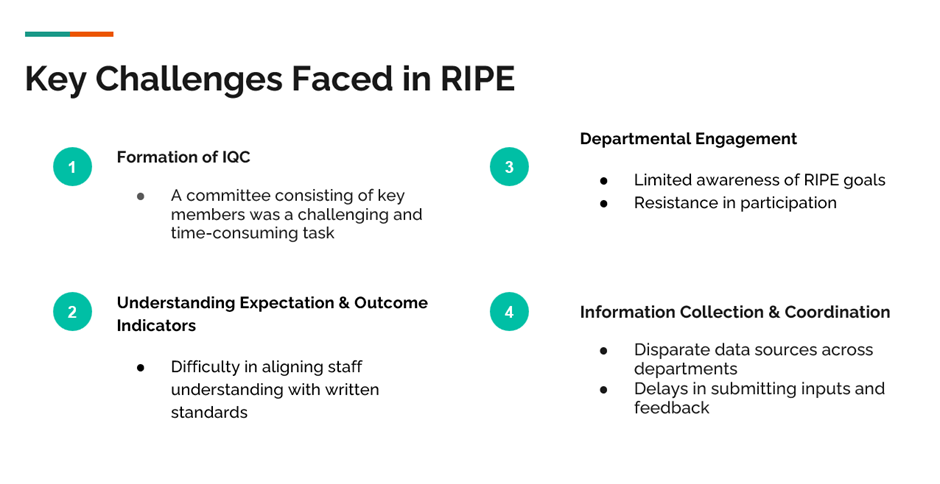
The move from IPE to RIPE has been a good step forward, but it has also created some challenges that many universities, including LUMS, have had to work through. One of the first problems was setting up the Institutional Quality Circle (IQC), the formation of which is mandated by the HEC, as the IQC is responsible for initiating the institutional self-assessment process. The IQC serves as a platform for discussion, alignment, and consultancy on quality enhancement initiatives and is comprised of senior leadership and key staff members of the institution. By bringing together representatives from across the institution, the IQC helps create ownership of the process and embeds a culture of continuous improvement. Although team formation is guided by HEC’s framework, the real challenge lies in convincing the top management and stakeholders to align around a single quality goal.
Another challenge was understanding the Expectation Outcome Indicators (EOIs) of RIPE since most of the staff in administration offices do not have awareness of QA processes. Understanding the EOIs was crucial for both OPE and the departments who had collaborated with OPE for the documentation of all the standards.
A third problem area was collecting and organizing information. Since LUMS works through many different departments and offices, the required data was spread across different departments. Bringing all this information together in an organized, timely, and accurate manner for RIPE reports requires repeated follow-ups.
Finally, getting everyone involved across the institution became a key issue. For RIPE to work, it needs active participation and awareness at every level including faculty and staff. Building this culture of involvement takes time, especially since RIPE is still quite new in Pakistan's higher education system. Making sure that people not only understand RIPE but also see its value is important for making it part of how the institution thinks.
Despite these challenges, the RIPE process has given LUMS a valuable chance to strengthen teamwork, clarify processes, and show its commitment to continuous improvement. The challenges, therefore, have not been setbacks, but learning experiences that help build a stronger and more resilient quality culture.
Way Forward for RIPE
LUMS is dedicated to continuously enhancing the RIPE initiative by gathering regular feedback from all departments, innovating new methodologies and best practices, strengthening collaboration and knowledge sharing, monitoring progress and adapting strategies for optimal performance. Together, we strive for excellence through ongoing learning and refinement.
Some steps LUMS intends to take in the near future include:
1. Encourage departmental level involvement: By providing faculty and administrative teams with a clearer understanding of RIPE standards, LUMS aims to strengthen ownership of the process beyond OPE. This ensures that improvement is not top-down but co-created at the departmental level. Departments possess a deeper and more accurate understanding of their core activities than the information that one can obtain from secondary sources such as websites or reports.
2. Streamline information collection via an annual coordination activity: This will reduce duplication of effort, improve consistency, and ensure that evidence for quality assurance is gathered proactively rather than reactively. Such streamlining also supports timely reporting. Since OPE already coordinates with departments for multiple projects, engaging departments on an annual basis would help minimize time lags and reduce the administrative burden associated with this quality assurance process.
3. Keep a track on the strategic initiatives and closing the loop: This means not only identifying areas for improvement but also following through on panel recommendations, measuring progress, and ensuring that change translates into beneficial outcomes.
Adding value to LUMS
Beyond meeting regulatory requirements, RIPE has given LUMS a structured opportunity to reflect on its practices and identify areas for growth. The framework encourages the university to go beyond compliance and adopt a mindset of continuous improvement. By engaging multiple stakeholders - faculty, staff, students, and leadership, RIPE has helped foster a culture of shared responsibility for quality. Since central offices have a better understanding of their core tasks and projects, LUMS was able to demonstrate a comprehensive explanation of different projects, schools, and tasks of each office. In our previous blog we discussed the aspect of the external reviewer. Having an external reviewer with extensive experience in QA and PhD level qualifications gave LUMS suggestions to work towards for the next 12 months. In this way, RIPE is adding long-term value to LUMS by positioning quality assurance as a driver of integrity, accountability, and institutional excellence.
Is this system really beneficial?
RIPE is still a relatively new framework, so it is natural to ask whether it is genuinely beneficial or simply another administrative exercise. From LUMS’ perspective, the answer leans towards the positive. Unlike IPE, which often felt like a compliance checklist, RIPE creates space for reflection, dialogue, and growth. It encourages universities to look beyond proving minimum standards and instead focus on how they can continuously enhance their practices. The process is not without challenges - particularly in terms of coordination and stakeholder engagement - but these challenges themselves push institutions to build stronger systems. In this way, RIPE is not just beneficial in meeting HEC requirements; it is valuable as a tool for institutional learning, accountability, and long-term development.
For LUMS, with its already established structures, functioning offices, and strong governance systems, RIPE has been useful mainly as a reflective and enhanced exercise. However, for smaller universities - many of which lack mature structures or a culture of internal accountability - RIPE can be even more beneficial. It provides a much-needed framework for building systems, organizing processes, and creating a culture of quality where little may have existed before. In this sense, RIPE is not only a compliance requirement but also a capacity-building tool, helping less-established institutions develop the foundations needed for long-term growth.
AI tools were used to assist with grammar refinement and readability improvements in this blog.

The author works as a Program Associate at OPE and has a double major in Economics and Finance from Lahore School of Economics. He has expertise in data analysis, economic modeling, and academic writing. Outside of his professional pursuits, he is an enthusiast of sports and creative endeavors.